Get a Quote
Tell us about your project needs.
Overview
Six Steps to Premium Reclaimed Lumber
Turning salvaged wood into a reliable, high-quality building material is not as simple as pulling nails and stacking boards. It requires expertise, specialized equipment, and an unwavering commitment to quality at every stage. At Houston Lumber, we have refined our process over more than fifteen years of hands-on experience with reclaimed materials of every species, grade, and condition.
Our six-step process ensures that every piece of lumber leaving our facility at 121 Esplanade Blvd in Houston meets the same standards our customers have come to expect: clean, accurately graded, properly dried, and ready to perform in its next life. Below, we walk through each stage in detail.
Sourcing
Every piece of reclaimed lumber begins its journey at a demolition site, renovation project, or surplus inventory. Houston Lumber maintains an extensive network of relationships with demolition contractors, property managers, industrial facility operators, and renovation crews throughout Louisiana, Mississippi, Texas, Alabama, and the broader Gulf South region.
When a structure is scheduled for demolition or a renovation generates surplus wood, we are often one of the first calls. Our team evaluates the material on-site, assessing species, dimensions, condition, and volume. We look for southern yellow pine, cypress, oak, Douglas fir, and other high-value species commonly found in the region's historic and industrial buildings.
We pay fair market value for salvageable lumber, which gives property owners and contractors a financial incentive to salvage rather than landfill. In many cases, we handle pickup and transportation ourselves using our own fleet of flatbed trucks, eliminating logistical barriers for the seller and ensuring the material is handled properly from the moment it leaves the source.
Our sourcing team has developed a keen eye for identifying high-yield opportunities. Industrial warehouses, agricultural buildings, and pre-war residential structures often contain large volumes of dense, old-growth lumber that was milled from virgin forests decades ago. This material features tight grain patterns, high density, and natural durability that modern plantation lumber cannot replicate. Identifying these sources before the material is lost to indiscriminate demolition is a critical skill that our team has honed over fifteen years in the field.
We also source from less obvious channels. Surplus lumber from construction projects that over-ordered, offcuts from millwork shops, and inventory liquidations from lumber yards all contribute to our supply. By casting a wide net and maintaining relationships across the construction ecosystem, we ensure a diverse and steady supply of reclaimed material that can meet a wide range of customer needs.
Every sourcing decision is documented. We maintain records of where each load originated, who we purchased it from, and the basic characteristics of the material. This chain-of-custody documentation ensures traceability and gives our customers confidence that the reclaimed lumber they purchase has been responsibly sourced and properly handled from the very beginning of the process.
Inspection
Once salvaged lumber arrives at our facility, every piece undergoes a thorough initial inspection. This is the most critical quality gate in our entire process — it determines whether a board enters our processing line, is redirected to a lower-grade application, or is removed from inventory entirely.
Our inspection team evaluates each piece for structural integrity, checking for rot, insect damage, excessive splitting, and compromised grain. We identify the wood species (critical for accurate grading and pricing), measure actual dimensions, and note any characteristics that may affect processing, such as embedded metal, paint, or chemical treatment. Boards with signs of hazardous treatment, such as creosote or CCA (chromated copper arsenate), are segregated and handled according to environmental regulations.
This inspection stage allows us to plan the processing path for each batch of lumber. Material destined for architectural or decorative use receives different handling than structural framing stock or fencing material. By sorting early, we maximize yield and ensure that every piece is directed to its highest and best use.
The inspection process also serves as a learning opportunity. Over the years, our team has developed extensive knowledge of regional building practices spanning more than a century. We can often identify the approximate era of construction, the original application of the lumber, and the likely species based on visual characteristics alone. This expertise informs processing decisions and helps us communicate accurately with customers about the history and characteristics of our reclaimed stock.
Moisture content is assessed during initial inspection using pin-type moisture meters. Lumber that arrives excessively wet is set aside for air drying before entering the processing line, as excess moisture can cause problems during planing and can lead to warping or checking if boards are kiln-dried too aggressively. Understanding the moisture profile of incoming material allows us to plan kiln schedules efficiently and avoid quality issues downstream.
Every inspection finding is recorded in our inventory management system. This data creates a profile for each batch of material that follows it through processing, grading, and sale. When a customer asks about the characteristics of a specific lot, we can provide detailed information about its origin, species, condition at intake, and processing history. This level of documentation is rare in the reclaimed lumber industry, and it is one of the things that sets Houston Lumber apart.
De-nailing
De-nailing is one of the most labor-intensive steps in reclaimed lumber processing, and it is one of the most important. Salvaged boards typically contain nails, screws, staples, bolts, and other metal fasteners that were embedded during the original construction, as well as any that were added during subsequent renovations over the decades.
Our de-nailing team uses a combination of hand tools and specialized pneumatic equipment to remove every piece of metal from each board. This is essential not only for the safety of end users but also to protect our downstream processing equipment. A single missed nail can destroy a planer blade or saw tooth, resulting in costly repairs and downtime.
After manual de-nailing, boards pass through a metal detection scan to catch any fasteners that may have broken off below the surface. Boards that fail the metal detection scan are returned for additional hand work. Only after a board passes this secondary check does it move to the processing stage. All recovered metal is collected and sent to a local scrap recycler, keeping yet another material stream out of the landfill.
The de-nailing process requires patience and a trained eye. Experienced de-nailers learn to read the surface of a board for telltale signs of embedded metal: slight discoloration around ferrous fasteners that have begun to rust, small bumps or dimples where nail heads were set below the surface, and patterns that indicate where structural connections were originally made. Some of our most experienced team members can identify and extract fasteners by feel alone, working through material at impressive speed while maintaining the thoroughness that our downstream processes demand.
Certain types of salvaged lumber present unique de-nailing challenges. Timbers from industrial buildings may contain lag bolts, through-bolts, and heavy-gauge structural connectors that require power tools for extraction. Boards from older residential construction may contain hand-forged nails that are more brittle than modern wire nails and prone to breaking off below the surface. Our team is trained to handle all of these situations and has the tools and experience to achieve a thorough result regardless of the fastener type.
The care we take during de-nailing directly impacts the quality of the finished product. Aggressive nail removal can leave gouges, splits, or enlarged holes that reduce the grade and value of the board. Our team is trained to extract fasteners with minimal damage, preserving as much usable wood as possible. This attention to detail during what many would consider a mundane step is a reflection of the craftsmanship standards that define Houston Lumber's approach to every aspect of our work.
Processing
With all metal removed, boards enter our processing line where they are transformed from rough salvage into finished, usable lumber. The specific processing steps depend on the intended end use and the customer's specifications, but our facility is equipped to handle virtually any requirement.
Planing removes the weathered outer surface of each board, revealing the clean, tight grain beneath. For customers who prefer the aged patina of reclaimed wood, we offer skip-planing, which cleans the surface while preserving some of the original character. Resawing allows us to cut thick salvaged timbers into thinner boards, dramatically increasing the usable yield from large-format material.
Kiln drying is a critical step for any lumber that will be used in interior applications or where dimensional stability is important. Our kilns reduce moisture content to industry-standard levels, typically between 6 and 12 percent depending on the species and application. Custom dimensioning services allow us to cut boards to specific widths, lengths, and thicknesses, delivering material that is ready to install with minimal on-site fabrication.
The processing stage is where our investment in equipment pays the greatest dividends. Our wide-belt planer can handle boards up to 24 inches wide in a single pass, producing surfaces that are smooth and consistent while preserving the natural character marks — nail holes, weathering patterns, and grain variations — that give reclaimed wood its distinctive appeal. The ability to control planing depth to within fractions of an inch allows us to remove only the minimum material necessary to achieve a clean surface, maximizing the final dimensions of each board.
Our resaw bandmill is capable of breaking down timbers up to 18 inches square. This machine is essential for maximizing the yield from large salvaged beams and posts. A single 12x12 timber can be resawn into multiple boards of various thicknesses, each one revealing the interior grain pattern that has been protected from the elements for decades. The resawing process requires skill and judgment — the operator must account for internal stresses in the wood that can cause boards to move during cutting, and must select cut patterns that maximize both yield and quality.
Custom processing requests are a regular part of our business. We work with architects, designers, and builders to produce reclaimed lumber to exact specifications: tongue and groove profiles for flooring and paneling, ship-lap edges for wall cladding, chamfered edges for exposed beam applications, and virtually any other profile that can be achieved with our equipment. This custom capability allows our customers to specify reclaimed material for applications that would otherwise default to new lumber, expanding the reach of reclaimed wood into new categories of construction and design.
Grading
After processing, every board is graded for both structural performance and visual quality. Grading is what separates a professional reclaimed lumber operation from a salvage yard. It is our promise to customers that the material they receive will perform as expected in their specific application.
Structural grading evaluates each board for load-bearing capacity based on species, grain orientation, knot size and frequency, and the presence of any defects such as checks, splits, or wane. Appearance grading assesses color consistency, surface quality, character marks, and overall aesthetic suitability. Moisture content is verified with a calibrated pin-type moisture meter to ensure proper drying has been achieved.
Graded lumber is then sorted by species, dimensions, grade, and intended application. This organized inventory system allows us to quickly fill orders with material that precisely matches our customers' requirements. Detailed grading information accompanies every shipment so that builders and designers know exactly what they are working with.
Our grading standards are informed by, but not identical to, the grading rules published by organizations like the Southern Pine Inspection Bureau (SPIB) and the Western Wood Products Association (WWPA). Because reclaimed lumber carries characteristics that are different from freshly milled material — historic nail holes, weathering patterns, natural patina — we have developed grading criteria that acknowledge these features while still providing meaningful and consistent quality distinctions. Our grading system categorizes material into clear tiers that communicate both structural capacity and visual character, giving customers a reliable basis for material selection.
Dimensional accuracy is verified during the grading process. Every board is measured for width, thickness, and length, and these measurements are checked against the target dimensions established during processing. Boards that fall outside acceptable tolerances are re-processed or re-categorized. This dimensional verification ensures that our customers receive material that fits their designs without unexpected surprises during installation.
The grading process is performed by experienced team members who have been trained to apply our standards consistently. We conduct regular calibration exercises where graders evaluate the same set of boards independently and compare their assessments to ensure consistency across the team. This investment in grading accuracy protects our customers and protects our reputation as a supplier of professionally graded reclaimed lumber.
Delivery
The final step in our process is getting the finished product to your site safely and on schedule. Houston Lumber operates its own fleet of flatbed trucks, giving us full control over the logistics chain from our facility to your project location. We serve customers throughout Louisiana, Mississippi, Texas, Alabama, Florida, and beyond.
Orders are carefully loaded and secured to prevent damage during transit. We use banding, edge protectors, and weather covers as appropriate for the material type and distance. Our drivers are experienced with lumber loads and understand the importance of proper handling, especially with reclaimed material that may include high-value architectural pieces.
For customers who prefer to pick up their orders, our Houston facility offers convenient loading with forklift assistance. We also coordinate with third-party freight carriers for long-distance shipments outside our standard delivery area. Regardless of how your order reaches you, our commitment is the same: the lumber you receive will match what you ordered, arrive on time, and be ready to use.
Delivery logistics for reclaimed lumber require particular care. Unlike uniform bundles of new dimensional lumber, reclaimed shipments often include a mix of dimensions, species, and grades that must be organized and secured according to their specific characteristics. Our loading team follows established protocols for stacking, separating, and securing mixed loads to prevent damage from shifting, rubbing, or compression during transit. High-value architectural pieces are individually wrapped or padded to protect finished surfaces.
We work with customers to schedule deliveries that align with their project timelines. For large commercial projects, we can stage multiple partial shipments to match construction sequencing, ensuring that material arrives when it is needed rather than sitting on-site where it could be damaged by weather or site activity. For residential customers, we offer delivery windows that accommodate homeowner schedules, including Saturday morning delivery by appointment.
Every delivery includes a detailed packing list that itemizes the material by species, dimensions, grade, and quantity. This documentation allows customers to verify their order upon receipt and provides a reference for any future questions about the material. Our drivers carry copies of all relevant documentation and are trained to walk through the delivery with the customer, answering questions and noting any concerns on the spot.
Inside Our Facility
Equipment Tour
Our facility at 121 Esplanade Blvd in Houston is equipped with industrial-grade machinery purpose-built for high-volume reclaimed lumber processing. This investment in equipment allows us to handle everything from rough-sawn barn wood to massive structural timbers with precision and efficiency. Here is a look at the major equipment that makes our process possible.
Wide-Belt Industrial Planer
Our primary planer handles boards up to 24 inches wide and 6 inches thick in a single pass, producing smooth, consistent surfaces while preserving the natural character of reclaimed grain patterns. The wide capacity means we can process large boards without ripping them down, maintaining maximum width and value. Depth-of-cut control allows us to remove only the minimum material necessary, preserving board thickness and the character marks that make reclaimed wood distinctive.
Resaw Bandmill
Capable of breaking down timbers up to 18 inches square, our resaw bandmill allows us to produce multiple thin boards from a single large piece, maximizing yield from salvaged material. The thin kerf of the bandsaw blade minimizes waste during cutting — a critical consideration when working with irreplaceable old-growth material. Our operators use their judgment and experience to select cut patterns that optimize both yield and quality from each piece.
Computer-Controlled Kiln System
Our kiln system has a total capacity of over 10,000 board feet per cycle. Temperature and humidity are precisely managed by computer controls that follow species-specific drying schedules. This precision prevents the checking, warping, and case-hardening that can occur when reclaimed lumber is dried too aggressively. Each kiln cycle is logged, and moisture readings are taken at multiple points throughout the charge to verify uniform drying.
Industrial Metal Detectors
Positioned at the transition between de-nailing and processing, our industrial metal detectors scan every board for embedded fasteners as small as a broken-off nail tip. The detection system uses electromagnetic induction to identify ferrous and non-ferrous metals at any depth within the board. Boards that trigger the detector are pulled from the line and returned for additional hand de-nailing before being re-scanned.
Pneumatic De-nailing Station
Our de-nailing workstations are equipped with pneumatic nail pullers, punch tools, and pry bars designed specifically for the types of fasteners commonly found in salvaged construction lumber. Adjustable work height tables reduce fatigue during this labor-intensive process. Overhead lighting ensures that operators can identify and extract every fastener, even in dense or darkly stained wood.
Radial Arm Saw and Chop Saw Station
Our cutting station includes heavy-duty radial arm saws and chop saws for trimming boards to length, squaring ends, and cutting out defects. These saws are equipped with carbide-tipped blades rated for reclaimed material and can handle boards of virtually any width and thickness we process. Precision fences and stops ensure accurate, repeatable cuts for orders that require specific lengths.
Centralized Dust Collection System
A high-capacity centralized dust collection system captures sawdust, chips, and fine particles throughout the facility. Ductwork connects every major piece of processing equipment to the collection system, which separates particles by size and directs them to appropriate collection points. This system maintains air quality for our team, reduces fire risk, and channels waste material to recycling partners for use in biomass energy, animal bedding, and composting.
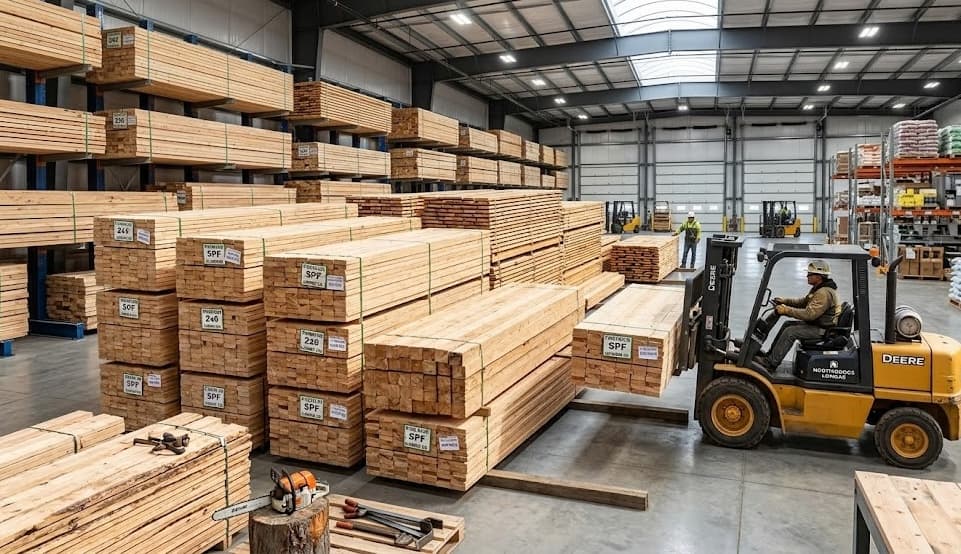
Forklift Fleet and Material Handling
We operate multiple forklifts with capacities ranging from 5,000 to 15,000 pounds for moving material throughout our facility and loading customer orders. Specialized fork attachments allow us to handle everything from individual timbers to banded bundles of dimensional lumber. Our material handling protocols ensure that lumber is supported properly during transport to prevent damage from bowing, racking, or contact with the ground.
Flatbed Truck Fleet
Our delivery fleet includes multiple flatbed trucks and trailers capable of hauling loads from small residential orders to full commercial shipments. Trucks are equipped with banding tools, edge protectors, tarps, and all necessary tie-down equipment to secure loads properly for highway transport. Regular maintenance schedules keep our fleet reliable and ensure we meet current emissions standards.
Moisture Measurement Instruments
We maintain a fleet of calibrated pin-type and pinless moisture meters used at multiple points in our process. Pin-type meters provide accurate readings at specific depths within the board, which is important for verifying that kiln drying has been effective throughout the full thickness of the material. Pinless meters allow rapid surface readings during sorting and grading. All meters are calibrated regularly against reference standards to ensure measurement accuracy.
Worker Protection
Safety Standards
Reclaimed lumber processing involves unique safety challenges that go beyond those found in conventional lumber operations. Salvaged wood may contain hidden nails, broken fasteners, lead paint residue, chemical treatments, and unpredictable structural weaknesses. Houston Lumber has developed comprehensive safety protocols that address these specific hazards while meeting or exceeding all OSHA requirements for wood processing facilities.
Every new team member completes a multi-day safety orientation before working on the processing floor. This orientation covers general woodworking safety, hazardous material identification, equipment-specific operating procedures, personal protective equipment (PPE) requirements, and emergency response protocols. Team members do not operate any equipment until they have demonstrated competency to a supervisor.
Safety is reinforced through weekly toolbox talks, monthly safety audits, and an open near-miss reporting system. When a hazard or near-miss is reported, it is investigated promptly and corrective action is taken. We track safety metrics including incident rates, near-miss reports, and audit findings, and we review these metrics in regular management meetings to identify trends and drive continuous improvement.
Personal Protective Equipment
All processing floor personnel are required to wear safety glasses, hearing protection, steel-toed boots, and cut-resistant gloves at all times. Additional PPE is required for specific tasks: face shields for grinding operations, respiratory protection when working with material that may contain lead paint, and high-visibility vests when working near mobile equipment. PPE is provided at no cost to employees and is inspected regularly for wear and damage.
Equipment Safety Guards and Lockout/Tagout
All processing equipment is fitted with manufacturer-specified safety guards, emergency stop controls, and anti-kickback devices. Our lockout/tagout program ensures that equipment is fully de-energized before any maintenance or adjustment work is performed. Every piece of equipment has a written lockout procedure posted at the machine, and all maintenance personnel are trained and authorized in lockout/tagout procedures.
Hazardous Material Protocols
Reclaimed lumber may contain lead paint, creosote, CCA (chromated copper arsenate), or other hazardous materials from its previous life. Our team is trained to identify the visual indicators of these treatments and to handle suspect material according to established protocols. Material confirmed to contain hazardous substances is segregated and disposed of through certified hazardous waste handlers — it never enters our processing line or our finished inventory.
Fire Prevention and Response
Wood processing facilities carry inherent fire risk from sawdust accumulation, hot equipment, and electrical systems. Our fire prevention program includes a centralized dust collection system that minimizes airborne and settled dust, regular inspection of electrical systems, prohibition of open flames in processing areas, and strategically placed fire extinguishers and fire suppression equipment. Our team is trained in fire extinguisher use and emergency evacuation procedures.
Typical Timelines
From Salvage to Your Site
One of the most common questions we receive is: how long does the process take from the time you source the lumber until it arrives at my project? The answer depends on the scope and complexity of the order, but here is a general timeline for typical project types. Keep in mind that we also maintain a large inventory of already-processed stock that can ship much faster for standard orders.
Small Residential Order (under 500 BF)
3 to 7 business daysFor standard species and dimensions that we carry in our processed inventory, small residential orders can typically ship within 3 to 5 business days. If custom processing is required — specific dimensions, skip-planing, or tongue-and-groove profiling — add 2 to 3 business days for processing. Delivery within the Houston metro area is typically next-day after the order is packaged.
Mid-Size Contractor Order (500 to 5,000 BF)
1 to 3 weeksContractor orders of this size may require pulling from multiple inventory lots or processing material from our rough-salvage stock. Standard species in common dimensions can often be fulfilled within 1 week. Specialty species, custom dimensions, or kiln-drying requirements may extend the timeline to 2 to 3 weeks. We work with contractors to align delivery scheduling with their project timelines.
Large Commercial Order (5,000+ BF)
2 to 6 weeksLarge commercial orders — for architectural projects, major renovations, or commercial construction — require careful planning and may involve sourcing additional raw material specifically for the project. We begin with a detailed consultation to understand specifications, then develop a processing plan with milestone dates. Staged deliveries are available to match construction sequencing. Complex orders involving rare species or highly specific grading requirements may require additional lead time.
Custom Architectural or Design Projects
3 to 8 weeksProjects that require hand-selection of individual boards, custom milling profiles, or material that must match a specific aesthetic standard require the most lead time. Our team works closely with architects and designers from the specification stage to ensure that the material we produce meets the creative vision of the project. Sample boards are often provided for approval before full production begins. These projects demand the highest level of craftsmanship and attention to detail.
In-Stock Standard Material (pickup or delivery)
Same day to 2 business daysFor customers who need material immediately and our standard processed inventory meets their needs, we can accommodate same-day pickup at our Houston facility or next-business-day local delivery. Our processed inventory includes a rotating selection of southern yellow pine, cypress, and oak in common dimensions and grades. Availability changes frequently, so we recommend contacting us at info@houston-lumber.com to check current stock before placing a time-sensitive order.
Ready to Put Our Process to Work?
Whether you need processing services for your own salvaged material or want to purchase ready-to-use reclaimed lumber, Houston Lumber has the equipment, expertise, and inventory to deliver.