Request a Quote
Tell us about your lumber needs.
Our Core Product
What Is Reclaimed Lumber?
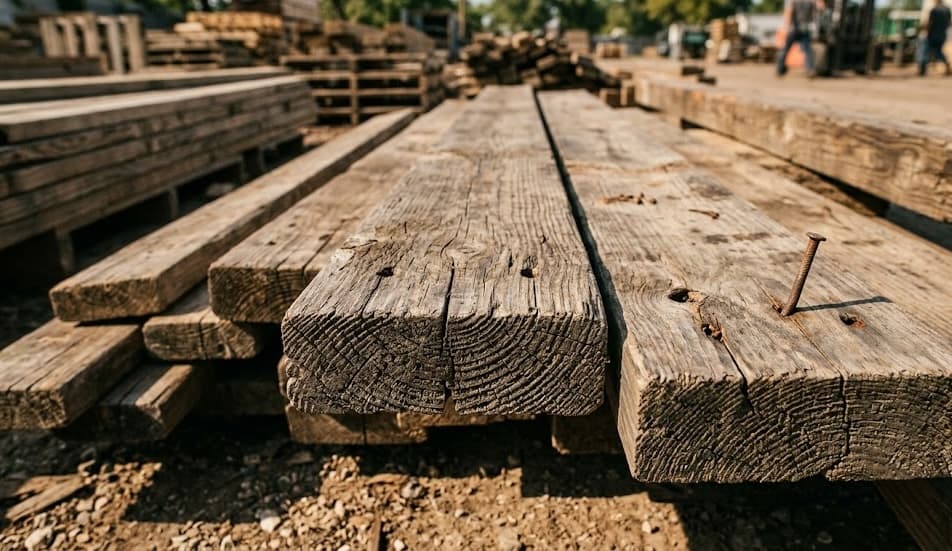
Reclaimed lumber is wood that has been salvaged from existing structures slated for demolition, renovation, or deconstruction. Rather than ending up in a landfill, this material is carefully removed, de-nailed, inspected, and processed for reuse in new construction, renovation, and design projects. At Houston Lumber, we source reclaimed wood from warehouses, factories, barns, residential homes, and commercial buildings across Louisiana, Texas, Mississippi, and the broader Gulf South.
The appeal of reclaimed lumber extends far beyond sustainability. Much of the timber found in structures built before the 1960s comes from old-growth forests that no longer exist in commercial quantities. These trees grew slowly over centuries, producing wood with tight growth rings, exceptional density, and natural resistance to warping and splitting. The result is a building material that is measurably stronger and more stable than most lumber produced by modern plantation forestry.
Beyond structural performance, reclaimed lumber carries a visual richness that simply cannot be manufactured. Decades of natural seasoning, exposure to the elements, and the marks of previous use — nail holes, saw marks, surface checking, and oxidized patina — create a character that architects, designers, and homeowners actively seek for both residential and commercial spaces. Every board tells a story.
Our reclaimed inventory is processed at our facility at 121 Esplanade Blvd in Houston, TX. Every piece passes through a multi-step workflow: initial inspection, de-nailing using industrial metal detectors, grading, and optional processing including planing, kiln drying, resawing, and profiling. The finished product is clean, safe, and ready to install — with all the character of the original material preserved.
Product Types
Types of Reclaimed Lumber We Carry
Boards & Planks
Flat-sawn boards from 1x4 through 1x12 and planks up to 2 inches thick. Ideal for sheathing, shelving, paneling, and general carpentry. Available rough-sawn or surfaced.
Dimensional Lumber
Standard framing sizes including 2x4, 2x6, 2x8, 2x10, and 2x12 in lengths up to 20 feet. Suitable for framing, blocking, and structural applications where reclaimed strength is an asset.
Sheathing
Reclaimed tongue-and-groove and shiplap sheathing salvaged from walls, floors, and roof decks. Excellent for accent walls, ceiling treatments, and rustic interior finishes.
Siding
Weathered clapboard, lap siding, and board-and-batten material with authentic aged surfaces. Perfect for exterior cladding, interior feature walls, and restoration work.
Flooring Stock
Thick planks and tongue-and-groove boards suitable for re-milling into hardwood flooring. We can process to your required thickness and profile on-site.
Specialty & Mixed Lots
Mixed species and dimension bundles for projects that benefit from variety — such as patchwork walls, furniture builds, or artistic installations. Priced by the bundle.
Technical Details
Product Specifications & Dimensions
A detailed reference of the standard dimensions, processing options, and pricing tiers for our reclaimed lumber inventory.
| Product Type | Nominal Sizes | Lengths | Processing Options | Price Range |
|---|---|---|---|---|
| Boards (1x) | 1x4, 1x6, 1x8, 1x10, 1x12 | 4 ft – 16 ft | Rough, S2S, S4S | $2.50 – $6.00 /bd ft |
| Planks (2x) | 2x4, 2x6, 2x8, 2x10, 2x12 | 8 ft – 20 ft | Rough, S2S, S4S, KD | $2.75 – $7.50 /bd ft |
| Sheathing (T&G) | 3/4 x 4, 3/4 x 6, 1 x 6 | 4 ft – 12 ft | As-is, Cleaned, Re-milled | $3.00 – $5.50 /sq ft |
| Siding | 3/4 x 6, 3/4 x 8, 1 x 8 | 4 ft – 14 ft | As-is, Cleaned, Sealed | $3.50 – $6.50 /sq ft |
| Flooring Stock | 3/4 x 3 through 3/4 x 12 | 2 ft – 12 ft (random) | T&G milled, KD, sanded | $6.00 – $14.00 /sq ft |
| Mixed Lots | Mixed widths and thicknesses | Random lengths | De-nailed, sorted | $1.50 – $3.50 /bd ft |
S2S = Surfaced Two Sides. S4S = Surfaced Four Sides. KD = Kiln Dried. T&G = Tongue and Groove. Prices vary by species, grade, and quantity. Contact us for a detailed quote.
Species Comparison
Reclaimed Species Head-to-Head
Each species offers distinct characteristics. Use this table to compare the most popular reclaimed woods side by side and choose the best fit for your project.
| Property | Heart Pine | Bald Cypress | White Oak | Red Oak | Douglas Fir | SYP |
|---|---|---|---|---|---|---|
| Janka Hardness (lbf) | 1,225 | 510 | 1,360 | 1,290 | 660 | 870 |
| Density (lb/cu ft) | 42 | 32 | 47 | 44 | 34 | 36 |
| Rot Resistance | High | Very High | High | Low | Moderate | Moderate |
| Best Applications | Flooring, millwork | Siding, exterior | Flooring, furniture | Interior paneling | Beams, framing | General framing |
| Color Range | Rich amber to deep red | Honey to silver-gray | Tan to light brown | Pink-red to light brown | Orange-red to tan | Yellow to light brown |
| Workability | Moderate (pre-drill) | Easy | Moderate (pre-drill) | Good | Easy | Easy |
| Relative Price | $$$$ | $$$ | $$$$ | $$$ | $$ | $ |
Wood Species
Available Species
Our reclaimed inventory changes regularly based on salvage operations. The following species are commonly available — contact us for current stock levels.
Southern Yellow Pine
Our most abundant species. Dense, strong, and versatile. Found in virtually every pre-war structure in the Gulf South. Accepts stain readily and machines well.
Bald Cypress
Louisiana's signature wood. Naturally rot-resistant, making it ideal for outdoor use, siding, and any application with moisture exposure. Distinctive grain pattern.
White Oak
Extremely hard and durable. Prized for flooring, furniture, and decorative millwork. Closed-grain structure resists moisture penetration. Takes finish beautifully.
Red Oak
Slightly more open-grained than white oak but equally strong. Excellent for interior flooring, paneling, and cabinetry components. Warm reddish tone.
Douglas Fir
Commonly found in industrial and warehouse framing. Straight-grained with outstanding structural strength. Popular for exposed beams and heavy timber applications.
Heart Pine
The heartwood of old-growth longleaf pine. Extremely dense, rich amber color, and highly sought-after for flooring and millwork. Increasingly rare and valuable.
Maple & Ash
Occasionally available from gymnasium floors, bowling alleys, and industrial flooring. Dense hardwoods ideal for tabletops, butcher blocks, and furniture.
Mixed Hardwoods
Bundles containing a variety of hardwood species. Cost-effective for projects where species consistency is not critical. Great for accent walls and mixed-media projects.
Where It Goes
Detailed Applications for Reclaimed Lumber
Residential Framing & Structural Work
Reclaimed 2x dimensional lumber is used for wall framing, floor joists, roof rafters, and blocking in residential construction. The higher density of old-growth framing lumber means better nail-holding power and less deflection under load. Check local code requirements regarding grade stamps for structural applications.
Hardwood Flooring
Reclaimed heart pine, oak, and cypress are among the most popular choices for wide-plank hardwood flooring. The tight grain and natural patina produce a floor with depth and warmth that new wood cannot match. We mill flooring in widths from 3 to 12 inches with tongue-and-groove profiles. Pre-finishing is available.
Accent Walls & Ceiling Paneling
Shiplap, tongue-and-groove, and board-and-batten reclaimed paneling creates dramatic accent walls, ceiling treatments, and wainscoting. Mixed-width installations add visual texture, and the natural color variation between boards creates an organic feel. Popular in living rooms, bedrooms, restaurants, and retail spaces.
Exterior Siding & Cladding
Reclaimed cypress and cedar siding offer natural rot resistance and authentic aged character for exterior applications. Clapboard, channel-cut, and board-and-batten profiles are available. Pair with a penetrating UV-resistant finish for maximum longevity in the Gulf South climate.
Furniture & Cabinetry
Artisan furniture makers and cabinet shops use our reclaimed hardwoods to create dining tables, shelving units, vanities, and custom cabinetry. The grain density and character of old-growth timber produce furniture with heirloom quality. We supply slabs, boards, and dimensioned stock for furniture-grade applications.
Restaurant & Retail Fit-Outs
The farm-to-table movement and the broader demand for authentic materials have made reclaimed lumber a staple of restaurant and retail design. Bar tops, feature walls, ceiling treatments, hostess stands, booth frames, and signage backing are common applications. We have supplied material for dozens of hospitality projects across the Gulf South.
Quality Assurance
How We Grade Reclaimed Lumber
Every piece of reclaimed lumber that enters our yard goes through a rigorous inspection and grading process. We evaluate each board for structural integrity, moisture content, insect damage, rot, and surface condition before assigning one of our standard grades.
Premium / Select — Clean, tight grain with minimal defects. Suitable for visible architectural applications including flooring, paneling, and furniture. Moisture content below 12%. No structural defects, insect damage, or rot. Minor character marks (small knots, light patina) add visual interest without compromising appearance.
No. 1 — Sound lumber with minor cosmetic imperfections such as small knots or limited checking. Excellent for general construction and semi-visible use. Moisture content below 15%. Structurally sound throughout.
No. 2 — Structurally sound with moderate character marks including knots, nail holes, and surface wear. Great for rustic applications, framing, and projects where character is desirable. Some variation in dimension is acceptable at this grade.
Utility / Economy — Functional lumber with visible wear, larger knots, and more dimensional variation. Ideal for temporary structures, industrial use, garden beds, compost bins, and budget-conscious projects where appearance is secondary. Priced aggressively for high-volume applications.
Why Reclaimed?
Benefits of Reclaimed Over New
Superior Density & Strength
Old-growth reclaimed timber is significantly denser than modern plantation wood. Tighter growth rings translate to greater hardness, better nail-holding power, and improved structural performance.
Dimensional Stability
Having dried naturally over decades in service, reclaimed lumber has reached equilibrium moisture content and is far less prone to warping, cupping, or twisting than freshly kiln-dried new lumber.
Environmental Impact
Every board foot of reclaimed lumber used is a board foot that does not require a new tree to be felled. It also diverts material from landfills, reducing both deforestation and waste.
Irreplaceable Character
Patina, nail holes, saw marks, and grain patterns developed over decades of use give reclaimed lumber a depth of character that no distressing technique can replicate.
Proven Longevity
Wood that has already survived 50 to 150 years in service has proven its durability. It has already passed the ultimate quality test: time.
LEED & Green Building Credits
Using reclaimed lumber contributes to LEED MR (Materials & Resources) credits, helping projects achieve green building certification and demonstrating environmental responsibility to clients and stakeholders.
Project Spotlight
Montrose Bungalow Renovation — 4,200 Board Feet
A homeowner in the Montrose neighborhood of Houston approached us to supply reclaimed lumber for a complete renovation of a 1920s bungalow. The project called for authenticity — materials that would match the era of the original construction while meeting modern performance standards. We supplied approximately 4,200 board feet of reclaimed material across multiple product types.
The flooring throughout the main living areas was milled from reclaimed heart pine sourced from a demolished cotton warehouse in Beaumont. We produced 1,400 square feet of 5-inch tongue-and-groove flooring, kiln dried to 8% moisture content and pre-finished with a hand-rubbed tung oil. The rich amber tones and tight grain of the heart pine complemented the home's original cypress millwork perfectly.
For the kitchen and bathroom, we supplied reclaimed white oak for custom countertops and vanity tops — thick slabs that were flattened, sanded, and sealed with a food-safe hardwax oil. The living room featured a reclaimed cypress mantel and shiplap accent wall behind the fireplace. All exterior siding repairs used reclaimed cypress clapboard boards to match the existing profile and weather pattern.
The project demonstrated the versatility of our reclaimed inventory — a single supplier providing flooring, countertop material, mantels, paneling, siding, and trim, all from documented Gulf South sources. The homeowner received a materials provenance letter documenting the origin of the major species, which added to the story of the renovation and was featured in a local home design magazine.
How to Order
Ordering & Logistics
Minimum Quantities
No minimum for will-call pickup. Delivery minimum is 200 board feet or $500 in product value. Custom processing orders require a minimum of 100 board feet per run to ensure efficient use of mill time.
Lead Times
In-stock rough lumber: 1 to 3 business days for local delivery. Surfaced or processed material: add 2 to 5 business days. Kiln-dried material: add 1 to 2 weeks depending on thickness and species. Rush processing available.
Custom Processing
We offer planing (S2S, S4S), resawing, tongue-and-groove profiling, shiplap milling, kiln drying, sanding, and wire brushing. Processing fees are quoted per order. Samples available before committing to a full run.
Volume Pricing
Pricing tiers at 500, 1,000, 2,500, and 5,000+ board feet. Contractor accounts receive additional discounts plus net-30 terms. Wholesale pricing available for lumber yards and building material dealers.
Delivery Options
Local flatbed delivery within 50 miles of Houston. Regional trucking across TX, LA, MS, AL. Nationwide LTL and full-truckload freight. Tailgate delivery and forklift unloading available. Crane service for heavy beams.
Quality Guarantee
All graded products carry our quality guarantee. If material does not match the stated grade upon delivery, contact us within 48 hours for replacement or credit. We stand behind every board we sell.
Protect Your Investment
Care & Maintenance for Reclaimed Lumber
Acclimation. Store reclaimed lumber in the environment where it will be installed for at least 7 to 14 days before cutting or fastening. Even well-seasoned reclaimed wood needs to adjust to the temperature and humidity of its final location. Stack boards on stickers with adequate air circulation.
Storage. Keep lumber off the ground on stickers or pallets with at least 4 inches of clearance. If storing outdoors, cover the top of the stack but leave the sides open for ventilation. Never fully wrap a stack in plastic — trapped moisture promotes mold and mildew growth.
Fastening. Dense reclaimed hardwoods benefit from pre-drilling to prevent splitting, especially near board ends. Use stainless steel or coated fasteners for outdoor applications and any environment with moisture exposure. For flooring installations, follow the nail or staple schedule recommended for the specific species and thickness.
Finishing Interior Applications. For interior installations such as flooring, paneling, and furniture, a penetrating oil finish (tung oil, hardwax oil, or Danish oil) enhances the grain and patina without creating a plastic-like surface film. Water-based polyurethane provides a harder protective layer for high-traffic flooring. Allow the finish to cure fully before placing furniture or allowing foot traffic.
Finishing Exterior Applications. For exterior siding, fencing, and decking, apply a penetrating UV-resistant sealant or semi-transparent stain within 48 hours of installation. Reapply every 1 to 3 years depending on exposure. Alternatively, many homeowners choose to let reclaimed wood weather naturally to a silver-gray patina, which requires no maintenance.
Ongoing Maintenance. Inspect annually for signs of moisture damage, insect activity, or fastener corrosion. Address any issues promptly — early intervention prevents small problems from becoming costly repairs. For flooring, sweep or vacuum regularly and damp-mop as needed. Avoid standing water on any wood surface.
Common Questions
Reclaimed Lumber FAQ
Is reclaimed lumber safe? Are there concerns about lead paint, chemicals, or pests?
Can I get enough matching material for a large project?
What is the typical moisture content of your reclaimed lumber?
Can reclaimed lumber meet building code requirements?
How does reclaimed lumber contribute to LEED certification?
Do you offer samples before I commit to a large order?
Quick Reference
Common Uses for Reclaimed Lumber
Explore More
Related Products & Resources
Explore our resource guides to make informed decisions about species selection, lumber grading, and sizing for your project.